Ground source heat pump systems—often referred to as geothermal systems—have long been recognized as one of the most energy-efficient ways to heat and cool buildings. By using the earth as a thermal battery, these systems can significantly reduce operational energy consumption while supporting electrification goals.
However, traditional geothermal systems come with practical limitations, particularly in dense urban environments where smaller parcels limit space for well fields.
A new technology known as the Darcy Dipole system is beginning to appear in projects across the United States. While still relatively new, the system introduces a different approach to exchanging heat with the ground, expanding the range of sites where ground source systems are viable.
This article summarizes what Engenium Group has learned so far through research and discussions with subject matter experts. Our goal is to help owners, architects, and engineers understand how the system works, where it may apply, and what questions to consider during early project planning.
Traditional Ground Source Heat Pumps: How They Work
Ground source heat pump systems often include two loops: the “outdoor” loop, which exchanges heat with the earth, and the “indoor” loop, which exchanges heat with building loads via heat pumps. A plate-and-frame heat exchanger is often provided to allow heat transfer between the outdoor loop and the indoor loop.
In urban/metropolitan environments, the outdoor loop is typically installed as a closed loop serving vertical U-bend wells. While other configurations are available, the vertical U-bend well approach offers benefits in urban areas, such as reduced site area requirements (when compared to a horizontal U-bend approach) and reduced environmental regulation (when compared to an open system).
In a typical closed system with vertical U-bend wells:
- Boreholes are drilled between 200 and 800 feet deep.
- Each well contains HDPE piping in a U-bend configuration.
- Water or a glycol solution circulates through the piping.
- Conductive heat transfer occurs between the fluid and the surrounding earth.
These wells are typically spaced about 20 feet apart, and in the DC/Maryland/Virginia (DMV) region, each well provides roughly 2 tons of equivalent heating or cooling capacity. The capacity per well is relatively small, so buildings with larger heating and cooling demands require large well fields, often consisting of dozens or even hundreds of wells.
For example:
- A 35,000 SF, 100-ton building requires approximately 50 wells.
- A 200,000 SF, 575-ton building requires approximately 288 wells.
While this approach works well for projects on large parcels, it can present challenges for urban/metropolitan sites where the area available for a wellfield is limited.
A Different Approach: The Darcy System
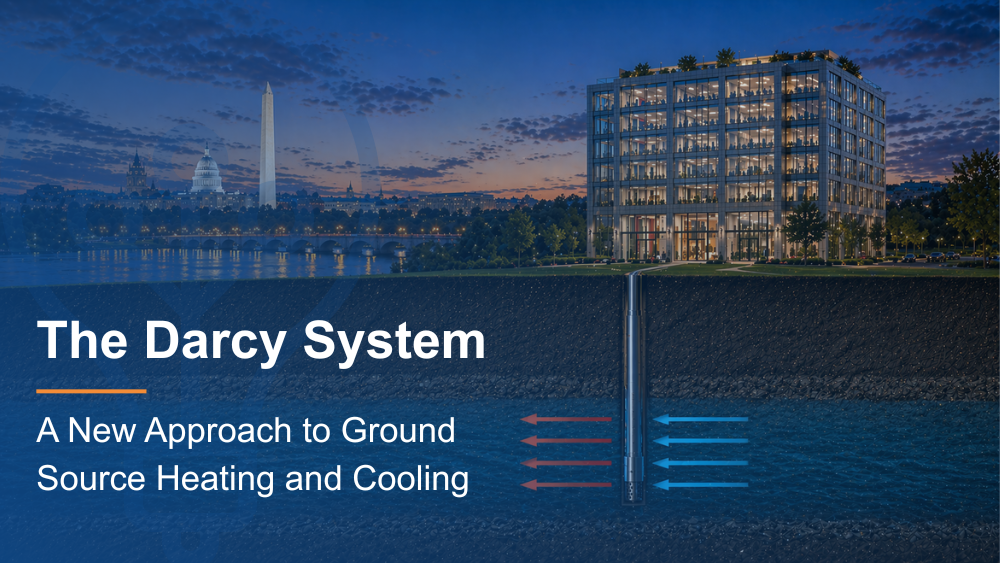
The Darcy System takes a different approach to exchanging heat with the earth. It uses the same indoor loop that a traditional system would use, but it adds a downwell heat exchanger to the outdoor loop and includes a third open aquifer loop to collect and motivate aquifer water across the downwell heat exchanger.
In this configuration:
- Outdoor loop water leaves the building and travels down a well in a closed loop.
- The outdoor loop water passes through a downhole heat exchanger.
- Aquifer water is motivated across the downhole heat exchanger via a submersible pump and discharged back into the aquifer – with no groundwater ever being removed from below ground
- Conductive and convective heat transfer occurs between the outdoor loop and the open aquifer loop.
The outdoor loop water does not come into direct contact with (or otherwise mix with) the aquifer water, limiting aquifer disturbance and potential for contamination. The well is designed for the specific geologic conditions of the site to minimize short cycling and maximize heat transfer.
Why the System Delivers Higher Capacity
Traditional ground source wells exchange heat with only the surrounding soil and rock. The surface area of a single well is limited by the well’s diameter and depth.
In contrast, the Darcy System exchanges heat directly with an aquifer, which greatly increases the contact area with surrounding soil and rock. This allows a single Darcy well to provide roughly two orders of magnitude more capacity (100x capacity) than a traditional vertical U-bend well.
- Traditional vertical U-bend well: ~2 tons per well in the DMV region.
- Darcy System: ~200 tons per well in the DMV region.
The capacities for both a typical ground source system and a Darcy System are driven by local, site-specific geology. The final capacities of typical ground source wells are dependent on soil conductivity, and the final capacities of the Darcy System wells are dependent on aquifer yield, but the above comparisons appropriately illustrate the comparative capacities of the two approaches.
Key Site Requirements
Local geology is the most important factor in determining whether the Darcy System is viable at a given project site. The system requires access to an aquifer with specific characteristics, including:
- Sufficient aquifer thickness to support groundwater circulation, often around 100 feet (but can vary with lithology and aquifer type)
- Adequate groundwater volume to enable significant aquifer pumping volumes for optimal heat transfer.
- No mixing between multiple aquifers at a given site.
If these requirements are not satisfied, the system may not be viable. Because aquifer conditions can vary dramatically over short distances, feasibility must be evaluated on a hyper-local, site-specific basis.
Site Investigation and Test Wells
The Darcy process typically begins with a feasibility evaluation using existing geological data, including stratigraphic layering maps and logs of existing wells drilled in the area. If the site appears to be viable based on initial review, Darcy Solutions will indicate potential viability and can provide preliminary system performance characteristics and budget pricing at that time. Darcy provides complimentary evaluations as part of their business development process, giving their customers a simple path to feasibility. A test well will be required to validate anticipated geologic characteristics critical to the final design of the wells.
Test wells are typically 6 inches or 8 inches in diameter and are used to confirm aquifer performance and groundwater conditions. A 6-inch test well may be repurposed for monitoring or irrigation purposes, and an 8-inch test well may be repurposed to increase the installed capacity of a system.
This testing phase typically occurs early in the design process, once the project team has developed a preliminary estimate of building heating and cooling loads.
Installation and Site Footprint
One of the most compelling advantages of the Darcy System is the reduction in site area required.
Regarding site area:
- Traditional ground source wells and Darcy System wells can be installed as close as 10 feet away from the perimeter of a building.
- A single Darcy System well can replace approximately 100 traditional ground source wells.
- Traditional wells are spaced 20+ feet apart on center, but Darcy System wells are typically spaced at least 100 feet apart.
A building may exist between Darcy System wells, further leveraging the reduced-site capabilities of a Darcy System.
Maintenance and System Lifecycle
Each Darcy System well has a lifespan similar to that of a municipal water well, with an expected service life of 75+ years.
Downwell equipment has lifespans commensurate with typical commercial/industrial equipment, and the following maintenance is anticipated for each Darcy System well:
- Immediately after drilling: Filter the open aquifer loop until particulate matter drops below 1 part-per-million (PPM).
- ~3-year cycle, ongoing: Re-inflate the well packer with nitrogen to maintain seals (wellhead service).
- ~15-year cycle, ongoing: Replace the open-loop pump (downwell equipment replacement).
- ~25-30-year cycle, ongoing (with 15-year parts warranty as standard): Replace the heat exchanger (downwell equipment replacement).
When downwell equipment reaches end-of-life, it is typically replaced in a single day. Planned replacements often occur during swing seasons to minimize operational disruption to the facility served. Darcy’s System is modular, and each well home-runs back to a common header in the mechanical space. The wells can be individually isolated from the rest of the system, allowing for continuous operation during routine maintenance events.
Cost Considerations
Costs vary significantly depending on location and geology.
In the DMV region, traditional ground source wellfields can cost around $20,000 per well. The cost of the Darcy System varies depending on site-specific geology, but is often between $3,000-$5,000 per ton of cooling. The cost of the Darcy System has been reducing over the last few years based on Darcy’s continual heat exchanger capacity increases.
Traditional ground source wells can often be more cost-effective for small projects below 50 tons of connected capacity. For larger projects with geologic conditions appropriate for a Darcy system, Darcy’s approach is usually more cost-effective. Darcy’s geologic evaluation process helps guide customers toward the appropriate solution for the geologic setting and system constraints.
Permitting and Regulatory Considerations
Because the Darcy System does not always fit neatly into the existing regulatory frameworks, jurisdictional review may involve additional environmental considerations.
The permitting framework for the Darcy system varies from state to state. Darcy has either had permits issued or has conceptual regulatory approval in more than 20 states, and permitting pathways may continue to evolve as the technology becomes more common and regulators become more familiar with the technology.
Risks and Unknowns
Like many emerging technologies, the Darcy System carries uncertainties.
Key considerations include:
- Limited long-term performance data – The earliest installed systems have been operating since 2020, which is a relatively short period of time compared to traditional HVAC infrastructure lifecycles.
- Dependence on site-specific geology – System feasibility and performance are highly dependent on aquifer characteristics, which can vary significantly within short distances.
- Evolving regulatory landscape – Because this approach introduces a newer method of interacting with groundwater, permitting requirements may vary and continue to develop across jurisdictions.
- Emerging track record at scale – While the Darcy system is intended to support large-scale and district energy applications through a modular well field approach, there are currently a limited number of installed systems at this scale. As a result, long-term performance and operational considerations for district applications are still being proven.
While early installations have demonstrated promising results, the technology is still relatively new.
Where the System May Make the Most Sense
Based on what we currently know, the Darcy System may be most attractive for projects that:
- Have cooling loads exceeding 50 tons and heating loads exceeding 500 MBH.
- Are located in dense urban environments or have limited space for conventional well fields.
- Have balanced annual heating and cooling loads.
- Sit above a sufficiently large aquifer.
Because the system depends heavily on local geology, feasibility must always be evaluated early in the project.
Looking Ahead
The Darcy System represents a revolution in ground source heat pump technology. By exchanging heat directly with groundwater rather than relying solely on conduction through soil and rock, it has the potential to significantly increase the capacity delivered by each well.
For architects and building owners pursuing electrification and high-efficiency building systems, technologies like this may expand the range of projects where ground source heating and cooling can be considered.
As with any emerging technology, thoughtful evaluation and early feasibility studies will be essential to determining where the system can be applied successfully.